
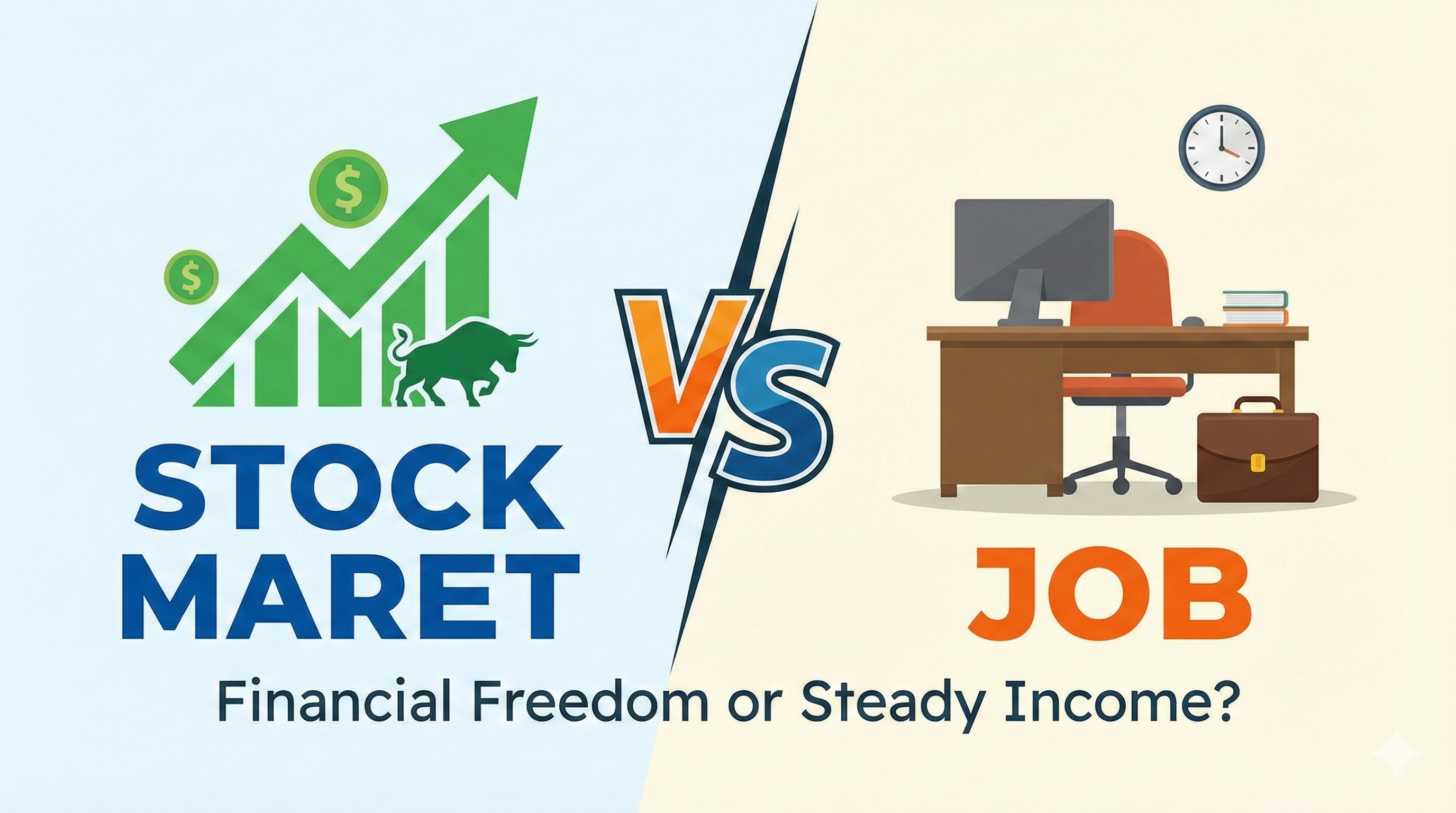

Stock Market as a Long-Term Income Source

The Global Shift Toward Market-Based Income
By 2026, the idea of relying only on a job for lifetime income is being questioned across the world. Rising inflation, economic cycles, layoffs, automation, and artificial intelligence are reshaping how people think about money and security. In this changing environment, the stock market has become more than a place for speculation. It is increasingly viewed as a long-term income system that rewards patience, ownership, and participation in global economic growth.
The stock market represents ownership in businesses. When you invest, you are not just buying symbols on a screen; you are buying pieces of real companies that produce goods, deliver services, and create value for society. As long as businesses grow and economies expand, long-term investors benefit. This fundamental connection between human progress and market growth is what makes the stock market powerful over decades.
Understanding How Stock Market Income Really Works
Ownership, Not Wages
Stock market income is fundamentally different from job income because it is not paid for time. In a job, income depends on hours worked, skills applied, or tasks completed. In the stock market, income depends on ownership. Once capital is invested, it works independently of the investor’s daily effort. This separation between time and income is one of the strongest advantages of market-based wealth.
Capital Growth Over Time
Long-term stock market income comes mainly from capital appreciation. As companies grow profits, expand operations, and increase efficiency, their value rises. Share prices reflect this growth over time. While prices fluctuate daily, the long-term trend of diversified markets has historically moved upward, driven by innovation, productivity, and population growth.
Dividends as a Growing Income Stream
Many companies share profits with investors through dividends. Over time, dividend income can become a reliable cash flow that grows faster than inflation. Unlike salaries, dividends can increase without promotions, negotiations, or extra work. For long-term investors, reinvesting dividends early and using them later for income is a powerful strategy.
The Power of Compounding in Long-Term Investing
Why Time Matters More Than Timing
Compounding is the process where returns generate their own returns. When gains are reinvested, growth accelerates over time. This effect becomes significant only with patience. Investors who stay invested for decades often outperform those who try to time the market. The stock market rewards time in the market, not perfect timing.
Small Amounts, Long Horizons
One of the most misunderstood aspects of stock market income is that large starting capital is not required. Consistent investing of modest amounts over long periods can build substantial wealth. The key is regularity and discipline, not size. Over time, compounding turns consistency into strength.
Global Access and Opportunity in 2026
Investing Is No Longer Elite
In 2026, access to stock markets is global and digital. People from different countries can invest in local and international markets with low fees and minimal barriers. Fractional shares, index funds, and online platforms have removed the need for large capital or professional connections. This global access allows individuals to participate in the growth of the world’s leading companies.
Exposure to Global Innovation
The stock market allows investors to benefit from technological and economic changes without needing to work directly in those industries. Artificial intelligence, renewable energy, biotechnology, digital finance, and automation are transforming the world. Investors gain exposure to these trends through ownership, even if their personal job is unrelated.
Risk: The Most Misunderstood Element
Volatility vs Real Risk
Many people fear the stock market because of volatility. Prices move daily, sometimes sharply. However, volatility is not the same as long-term risk. Real risk comes from poor diversification, emotional decisions, and short-term thinking. Historically, diversified markets have recovered from crises and continued growing over time.
The Emotional Challenge
The biggest enemy of stock market success is not market crashes but human behavior. Fear causes investors to sell at low prices, while greed pushes them to buy at high prices. Long-term investors learn to control emotions, follow a plan, and ignore short-term noise. Emotional discipline matters more than intelligence or prediction skills.
Stock Market Income vs Inflation
Protecting Purchasing Power
Inflation reduces the value of money over time. Cash savings and fixed incomes lose purchasing power silently. The stock market, however, represents ownership in businesses that adjust prices, improve efficiency, and groww earnings. This makes stocks one of the most effective long-term inflation hedges.
Wealth That Grows With the Economy
As economies expand, businesses generate higher revenues. Investors benefit from this growth directly. Over long periods, stock market returns have historically exceeded inflation, helping investors maintain and grow real wealth rather than just nominal values.
Flexibility and Freedom of Market-Based Income
No Income Ceiling
Unlike jobs, where income is limited by role, time, and organizational structure, stock market income has no fixed ceiling. As capital grows, returns grow proportionally. This scalability makes the market attractive for those seeking financial independence rather than just stability.
Lifestyle Flexibility
Stock market income does not require physical presence or fixed schedules. Investors can travel, change careers, or take breaks without losing ownership. This flexibility becomes increasingly valuable in a world where people prioritize freedom, health, and balance over traditional career paths.
Tax Efficiency and Structural Advantages
Favorable Long-Term Treatment
In many countries, long-term investing receives better tax treatment than earned income. While rules vary globally, investors often benefit from lower tax rates, deferral options, and strategic withdrawals. Over decades, this structural advantage significantly improves net returns.
Planning Across Life Stages
Stock market income can be adapted to different life stages. Early years focus on growth and reinvestment. Later years focus on income and capital preservation. This adaptability makes investing a lifelong financial tool rather than a single-purpose strategy.
The Role of Automation and AI
Jobs Change Faster Than Markets
Automation and artificial intelligence are reshaping job markets worldwide. Skills become outdated, roles disappear, and competition increases. The stock market allows individuals to benefit from productivity gains instead of being threatened by them. Investors profit from innovation rather than compete against it.
Ownership Over Employment
As machines replace tasks, ownership becomes more valuable than labor. The stock market provides access to ownership in automated, scalable businesses that generate income with minimal human input.
Common Myths About Stock Market Income
“It’s Only for Experts”
Long-term investing does not require complex strategies. Simple, diversified approaches often outperform complicated systems. Education matters, but perfection does not.
“It’s Too Risky for Regular People”
Avoiding the stock market can be riskier than participating in it. Inflation, job loss, and stagnating wages pose long-term risks that investing helps address.
“You Need to Watch It Every Day”
Successful long-term investors often do less, not more. Over-monitoring increases emotional decisions and reduces returns.
The Reality Check
Stock market income is not effortless or guaranteed. It requires patience, discipline, and a willingness to endure uncertainty. Short-term losses are part of the journey. Those who treat investing as gambling usually fail. Those who treat it as a long-term ownership system often succeed.
Job as a Long-Term Income Source

The Traditional Role of Jobs in Human Society
For centuries, jobs have been the primary source of income for individuals across the world. From farming and craftsmanship to corporate employment and professional services, work has been the foundation of survival, identity, and social structure. Even in 2026, despite rapid technological change, jobs remain the most common and immediate way people earn money to meet daily needs.
A job provides structure, predictability, and a clear exchange of value. You offer time, skills, and effort, and in return, you receive a salary or wage. This simple model has supported billions of lives and continues to do so. While debates about long-term income alternatives grow louder, the role of jobs cannot be dismissed or ignored.
How Job Income Works in the Modern World
Time-for-Money Exchange
At its core, job income is linear. You are paid based on hours worked, responsibilities handled, or value delivered within a defined role. Whether hourly or salaried, income is directly connected to presence and performance. When work stops, income usually stops as well. This direct relationship creates stability but also limits scalability.
Skill-Based Progression
Income growth in jobs typically depends on skill development, experience, and career progression. Promotions, role changes, and performance bonuses can increase earnings. However, this growth is often gradual and competitive. Opportunities depend on organizational structure, industry health, and economic conditions beyond individual control.
Stability: The Biggest Strength of Jobs
Predictable Cash Flow
One of the strongest advantages of a job is predictable income. Monthly salaries allow people to plan expenses, manage debt, and maintain a consistent lifestyle. For many, this reliability reduces stress and provides psychological security, especially in uncertain economic times.
Social and Financial Systems Built Around Jobs
Globally, financial systems are designed around employment. Loans, mortgages, credit approvals, insurance policies, and retirement plans often depend on stable job income. This integration makes jobs a practical foundation for financial life, especially in early and mid-career stages.
Jobs and Human Identity
Purpose and Belonging
Jobs provide more than money. They offer structure, social interaction, and a sense of purpose. Many people define themselves by what they do. Work creates routines, goals, and community, which contribute to mental and emotional well-being.
Learning Through Experience
Jobs expose individuals to real-world challenges, teamwork, leadership, and problem-solving. These experiences build transferable skills that extend beyond income. Even when people change careers, the lessons learned through employment often remain valuable.
The Limits of Job-Based Long-Term Income
Income Ceiling and Time Constraints
No matter how skilled or dedicated someone is, job income has limits. Time is finite, and energy declines with age. There are only so many hours in a day and years in a career. Even high-paying roles face ceilings imposed by organizations, markets, and physical endurance.
Dependency on External Decisions
Job income depends heavily on factors outside individual control. Company performance, management decisions, economic downturns, and industry disruptions can affect employment suddenly. Even loyal, high-performing employees are not immune to layoffs or restructuring.
The Impact of Technology and Automation
Rapid Skill Obsolescence
In 2026, technology evolves faster than ever. Skills that are valuable today may become outdated within years. Continuous learning is no longer optional. Workers must constantly adapt to new tools, systems, and processes just to remain relevant.
Job Displacement Risks
Automation and artificial intelligence are replacing repetitive and predictable tasks across industries. While new roles emerge, transitions are not always smooth. Many workers face uncertainty, reskilling pressure, and increased competition in global labor markets.
Income Growth vs Cost of Living
Salary vs Inflation
In many regions, wages struggle to keep pace with inflation. While costs of housing, healthcare, education, and essentials rise steadily, salary increments are often modest. Over long periods, this gap reduces real purchasing power, even for employed individuals.
Lifestyle Inflation Trap
As income increases, expenses often increase as well. Better housing, transportation, and lifestyle choices absorb higher earnings. Without disciplined financial planning, higher salaries do not automatically lead to wealth accumulation.
Work-Life Balance and Health
The Physical and Mental Cost of Jobs
Many jobs demand long hours, constant availability, and high stress. Over time, this can affect physical health, mental well-being, and relationships. Burnout is increasingly common across professions worldwide.
Time as the Hidden Cost
Jobs consume time during the most productive years of life. Commuting, meetings, and deadlines reduce personal freedom. While work provides income, it often limits flexibility in how time is spent.
Career Longevity and Aging
Declining Energy and Opportunity
As people age, energy levels and adaptability may decline. Some industries favor younger workers due to cost or perceived innovation. Career growth can slow or stagnate later in life, even for experienced professionals.
Retirement Uncertainty
Traditional retirement models based solely on job income are under pressure. Longer lifespans, rising costs, and unstable pension systems create uncertainty. Many retirees find that job-based savings alone are insufficient for long-term security.
Jobs Still Matter in 2026
Entry Point to Financial Life
For most people, a job is the starting point. It provides the first steady income, builds discipline, and enables saving and investing. Without earned income, participation in other wealth-building systems is difficult.
Funding Other Income Sources
Job income can be used strategically to build long-term assets. Many financially successful individuals use salaries to invest in markets, businesses, or skills. In this sense, jobs act as fuel rather than the final destination.
The Emotional Security of Employment
Certainty in an Uncertain World
Despite limitations, jobs offer emotional comfort. Knowing that money will arrive at a fixed time reduces anxiety. This certainty is valuable, especially for families, dependents, and individuals who prioritize stability over growth.
Clear Expectations
Jobs come with defined roles, responsibilities, and goals. This clarity appeals to people who prefer structured environments and measurable progress rather than uncertainty.
Common Myths About Job Income
“A Job Guarantees Security”
No job is truly permanent. Security comes from adaptability, skills, and financial planning, not from a single employer.
“High Salary Means Wealth”
High income does not guarantee wealth. Without saving and investing, even large salaries can disappear through expenses and taxes.
“Hard Work Always Pays More”
Effort matters, but income growth also depends on market demand, negotiation, timing, and opportunity. Hard work alone is not always rewarded proportionally.
The Reality of Job-Based Long-Term Income
Jobs are reliable but limited. They provide stability but not scalability. They support daily life but rarely create financial freedom on their own. For long-term income, jobs perform best when combined with other systems rather than used in isolation.
In 2026, jobs remain essential but insufficient as a sole long-term income strategy. They offer structure, predictability, and social value, but they are constrained by time, energy, and external control. Relying only on a job exposes individuals to inflation, disruption, and career uncertainty.
Stock Market vs Job
The real question in 2026 is not stock market or job. It is how effectively a job is used to build long-term income beyond employment. Jobs pay the bills. Ownership builds wealth. Those who understand this difference position themselves for both stability and freedom over time.