

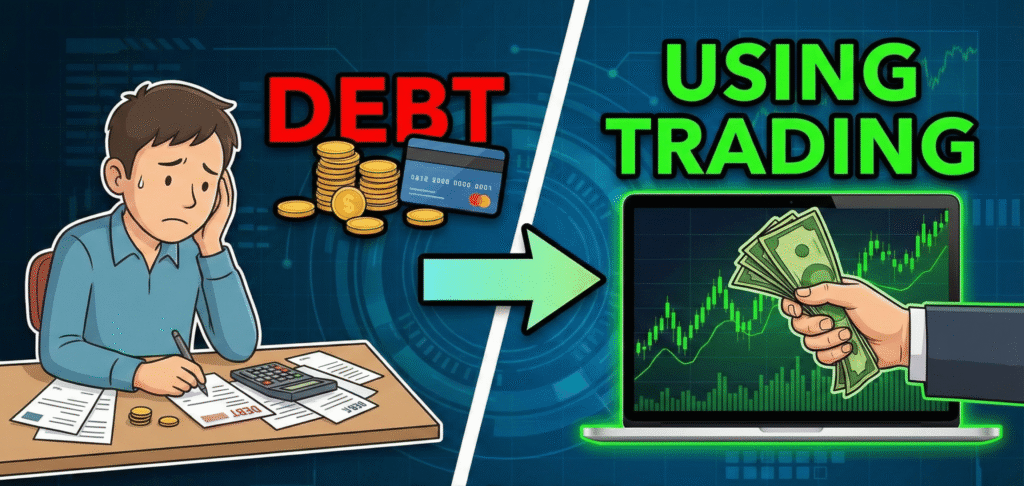
Many new traders enter the market with big dreams and limited capital. When profits seem slow or opportunities feel just out of reach, a tempting idea often appears: “What if I trade with borrowed money?” Loans, credit cards, personal borrowing, or margin trading can make capital instantly available. Along with that comes another dangerous thought — can trading with borrowed money give 100% winning results?
This blog explores that idea honestly and realistically. We will break down whether it is possible to achieve a 100% win rate using borrowed money, what risks are involved, and whether it is a smart decision for traders at any level.
Should We Trade Using Borrowed Money or Not?
This is one of the most important questions a trader can ask.
At first think, trading with borrowed money looks attractive. More capital means bigger positions, and bigger positions mean bigger profits — at least in theory. If a trade moves in your favor, profits grow faster. This illusion often convinces people that borrowed money can accelerate success.
But trading does not work on certainty. Markets move based on countless factors — economic news, global events, emotions, institutional activity, and pure randomness. No trader, strategy, or system can predict the market with 100% accuracy. When borrowed money enters this uncertain environment, the risk multiplies.
Borrowed money always comes with pressure. Unlike your own capital, it must be repaid. Losses are not just numbers on a screen; they become real-life financial pressure. This pressure affects decision-making. Traders start holding losing positions too long, overtrading to recover losses, or taking excessive risks to “win back” money quickly.
In short, while trading with borrowed money is possible, it is not advisable, especially for beginners or emotionally unprepared traders.
100% Winning in Trading is myth
The concept of the ‘100% win rate’ is one of the biggest trading myths. Even the most successful traders in the industry don’t win all their trades. Experienced traders don’t aim for perfection.
A trader can still make profits with only a 40-60% winning rate provided the losses are managed well and the winning trades are allowed to run. Seeking to achieve a perfect winning rate of 100% typically results in a trader’s downfall.
When it involves the money loaned, the myth is much riskier. A mere unexpected move of the markets can destroy not only your trading portfolio but also your personal financial security.
Emotional Stress
Fear is already a part of trading, but borrowed money turns fear into constant pressure. When you trade with your own savings, losses hurt, but they are manageable. When the money belongs to someone else, every price movement feels heavier. Traders start watching charts obsessively, reacting emotionally instead of logically. Small pullbacks feel like disasters, and normal market volatility becomes unbearable.
This emotional stress often leads to panic actions such as exiting good trades too early, moving stop losses unnecessarily, or jumping into random trades just to feel “in control.” Over time, stress affects sleep, focus, and confidence. A stressed trader cannot follow a plan consistently. Trading requires patience and clarity, but borrowed money replaces calm thinking with fear-driven decisions. When emotions control trades, even good strategies fail, turning what could have been temporary losses into permanent damage.
No Room for Error
Trading success depends on allowing room for mistakes. Every trader, no matter how skilled, faces losing streaks. When trading with personal capital, you can reduce position size, pause trading, learn from errors, and slowly recover. Borrowed money removes this flexibility. There is no patience built into debt. Interest accumulates, deadlines approach, and losses feel urgent.
Traders feel forced to “fix” mistakes immediately, often by taking higher risks. This pressure eliminates the learning phase that all successful traders go through. A single bad trade or market event can wipe out months of effort. Without room for error, traders cannot grow, adapt, or survive drawdowns. Trading without margin for mistakes is not trading — it is gambling under pressure, where even a small misstep can cause irreversible financial consequences.
Forced Decisions
Markets move independently of personal financial situations. They do not care about loan repayment dates, credit card bills, or borrowed deadlines. When trading with debt, traders often face forced exits — closing trades not because the market signals it, but because money is needed elsewhere. This leads to selling at losses or missing profitable moves.
Forced decisions destroy strategy consistency. Instead of following a trading plan, traders begin reacting to external pressure. They exit winning trades too early, hold losing trades too long, or avoid good opportunities out of fear. Over time, trading becomes reactive rather than planned. The market rewards discipline and timing, not desperation. When repayment pressure controls decisions, traders lose their ability to think objectively. Forced decisions turn manageable market risk into uncontrollable personal risk, often locking in losses that could have been avoided with patience.
Overleveraging
Borrowed money often creates a false sense of confidence. Traders believe that larger capital means higher profits, so they increase position size beyond safe limits. This is known as overleveraging. While profits may look impressive during winning trades, losses grow just as fast — or faster. A small unfavorable price move can cause massive drawdowns or even account wipeouts.
Overleveraged traders have little tolerance for normal market fluctuations. Stop losses are hit frequently, margin calls occur suddenly, and emotional reactions escalate. Instead of managing risk, traders focus only on potential gains. Overleveraging removes balance from trading. It converts a probability-based activity into a high-risk bet. Sustainable trading requires controlled position sizing, but borrowed money tempts traders to ignore limits, making losses unavoidable and recovery extremely difficult.
Financial Damage Beyond Trading
Losses from borrowed money trading do not stay confined to the trading account. They spill into real life. Failed trades can strain family relationships, create guilt, and damage trust. Financial stress affects mental health, leading to anxiety, depression, and loss of confidence. Missed repayments can harm credit scores, limiting future financial opportunities. Long-term goals like education, business plans, or home ownership may be delayed or destroyed. Unlike normal trading losses, debt-related losses follow you daily through reminders, calls, and obligations.
This creates a cycle of stress where traders feel trapped — trying to trade more to escape losses, but worsening the situation. Trading should support life, not damage it. When borrowed money causes harm beyond the screen, the true cost of trading becomes far higher than any financial loss.
Trading debt can be recovered, but only with slow progress, consistency, discipline, and the right mindset.
Slow Recovery
Recovering from trading debt is possible, but it never happens quickly or easily. The biggest mistake traders make after going into debt is trying to recover everything fast. This usually leads to revenge trading, oversized positions, and emotional decisions that deepen losses. Real recovery begins when a trader accepts that progress must be slow. Small, controlled profits matter more than big wins. Trading with reduced position size allows the account to survive market fluctuations and gives the trader time to rebuild confidence. Slow recovery also protects mental health, reducing stress and fear.
When traders aim for steady improvement instead of instant success, they develop patience — one of the most valuable trading skills. Markets reward those who stay calm and consistent, not those who rush. Accepting a slow recovery is not weakness; it is maturity. It shows understanding that trading is a long-term process where survival and stability come first, and profits follow later.
Consistency
Consistency is the foundation of recovering from trading debt. One or two winning trades cannot repair financial damage. What matters is repeating correct actions every day, regardless of short-term results. Consistent traders follow the same strategy, position sizing, and risk rules without exception. They do not change methods after a loss or overtrade after a win. This steady approach rebuilds both capital and confidence over time. Consistency also helps traders understand their edge — what works and what does not. Without consistency, results become random and recovery becomes impossible.
Many traders fail not because their strategy is bad, but because they apply it inconsistently. When recovering from debt, consistency brings emotional stability. It reduces fear and overthinking because decisions are planned, not reactive. In the long run, consistent behavior matters more than intelligence, luck, or market conditions. Trading success comes from repeating simple actions correctly over a long period of time.
Discipline
Discipline separates traders who recover from those who collapse further into debt. Discipline means following rules even when emotions say otherwise. It means accepting losses without breaking risk limits. A disciplined trader respects stop losses, avoids impulsive trades, and knows when not to trade at all. This is especially important during debt recovery, where one emotional mistake can erase months of effort.
Discipline also involves lifestyle choices — proper sleep, reduced screen time, and avoiding constant market exposure. Many traders believe discipline is about willpower, but it is actually about preparation. Clear rules remove emotional decision-making. When discipline is strong, fear and greed lose control. Over time, disciplined actions build trust in the process. That trust allows traders to stay focused during difficult periods. Without discipline, even the best strategy will fail. With discipline, even average strategies can produce long-term recovery and stability.
Mindset
Mindset is the most important factor in recovering from trading debt. A trader’s mindset determines how they react to losses, pressure, and uncertainty. A weak mindset seeks shortcuts and guarantees. A strong mindset accepts uncertainty and focuses on process over results. Debt recovery requires humility accepting past mistakes without self-blame.
Traders must stop seeing the market as an enemy and start seeing it as a probability-based environment. A healthy mindset understands that losses are part of trading, not personal failures. It also avoids comparison with others, which often leads to frustration and overtrading. Instead, the focus stays on personal growth and improvement. Mindset affects patience, discipline, and consistency. Without the right mindset, recovery becomes emotionally exhausting. With the right mindset, even slow progress feels meaningful. Trading success begins internally, long before it shows in account balance.
Warren Buffett’s Investment Theory

Warren Buffett’s investment theory is built on simplicity, patience, and discipline. He believes that successful investing is not about predicting markets or trading frequently, but about owning high-quality businesses for the long term. According to Buffett, the stock market is a place where money moves from the impatient to the patient. This highlights his core belief: time is the biggest advantage an investor can have.
One of Buffett’s most important principles is value investing. He looks for companies that are fundamentally strong but temporarily undervalued by the market. Instead of focusing on short-term price movements, he studies a company’s earnings, management quality, competitive advantage, and long-term growth potential. If the market price is lower than the company’s true value, Buffett sees it as an opportunity, not a risk.
Another key concept in Buffett’s theory is the economic moat. He prefers businesses that have a strong competitive advantage — such as brand loyalty, pricing power, or cost efficiency — which protects them from competitors. Companies like Coca-Cola and Apple fit this idea because their products are deeply embedded in consumers’ lives.
Buffett also strongly believes in risk management. For him, risk does not mean volatility; risk means not understanding what you are investing in. That is why he avoids businesses he cannot clearly understand, even if they appear profitable.
Finally, Buffett emphasizes emotional control. He advises investors to be fearful when others are greedy and greedy when others are fearful. By controlling emotions and staying focused on fundamentals, investors can build long-term wealth steadily and safely.
In short, Warren Buffett’s theory teaches that successful investing comes from patience, knowledge, and disciplined decision-making — not from speculation or quick profits.
Final Thoughts
Success in trading while using debt is possible, but only under very strict conditions. It is not guaranteed, easy, or fast. If a trader truly follows the right steps — slow recovery, consistency, strong discipline, and a healthy mindset — long-term improvement can happen. The key is treating trading as a professional process, not a shortcut to quick money. Every decision must be planned, risks must be controlled, and emotions must be managed carefully. Without following these principles, trading with debt almost always leads to failure. Success does not come from borrowed money itself, but from how responsibly and patiently a trader uses it.


Pingback: Stock Market vs Job in 2026: The Better Choice for Long-Term Income - dcwealthengine.com